
Resources
Writing · Concepts · Practical Tips
A curated space for reflection on the theory behind dowsing — and concrete guidance for bringing energy awareness into everyday life.
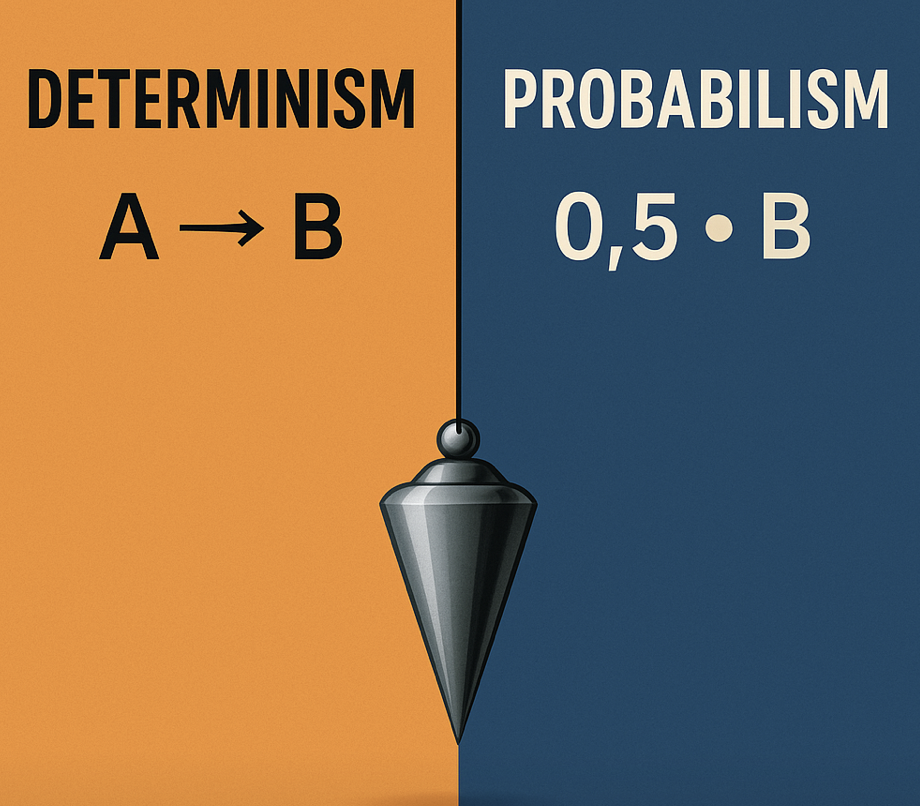
Deterministic vs Probabilistic Choice in Dowsing
Two distinct logical frameworks govern how we make decisions — and understanding their difference is key to practising dowsing with rigour and integrity.
Determinism
The law of cause and effect
If cause A occurs, effect B follows — reliably and reproducibly. The link between cause and consequence is certain.
Probability
Working with uncertainty
Evidence and data raise or lower the likelihood of a result — without guaranteeing it.
Dowsing and probabilistic logic
In dowsing, we speak of degrees of probability — not absolute truths. Estimated probability depends on:
- the quality and quantity of concrete facts — observable data, history, context
- the reliability of sources of information
- the coherence across multiple indicators
- the practitioner's method and experience
- the time-bound context: what is true here and now may not hold later
If I have a sore throat, a pharmacist may suggest several remedies. Among these options, dowsing can help me prioritise the one showing the highest estimated probability of relieving my symptoms — here and now, for me personally.
Responsible use — important notice
Dowsing is not a substitute for professional medical, legal or financial advice. Do not discontinue prescribed treatments without consulting a qualified professional. Use dowsing as a complementary, personal decision-support practice.
Spinoza and Pascal
Spinoza's determinism describes a world governed by necessary chains of causes — a universe where everything follows with logical necessity. Pascal's wager highlights the art of acting under uncertainty: assigning and living with probabilities when certainty is not available.
Dowsing aligns with the latter tradition. It seeks an enlightened, probabilistic estimation — an acknowledgement that the universe offers information, not guarantees, and that wisdom lies in reading that information with both rigour and humility.
A few tips for everyday energy awareness
Small adjustments to your environment, food choices and daily habits can meaningfully raise the vibrational quality of your life.

Creating a sacred space
A statue, some stones, incense — a space that reflects an emanation of the sacred and enhances the energy of your home.

Placing sacred objects
Sacred objects need to be placed at a high-vibrational point — dowsing helps identify the right location.

Storing essential oils
High-vibration oils like Italian helichrysum need suitable storage — avoid electromagnetic spaces. A drop of cypress oil offers some protection.

Grounding after screens
After long hours at a computer, walking barefoot on the earth acts as a natural grounding — restoring energetic balance.

Olive oil & electricity
Olive oil is very sensitive to electromagnetic fields. Keep it away from electrical outlets and appliances.

Energising your water
Shake your water bottle before drinking to revive the water. A vortex tap attachment serves the same purpose.

Timing supplements
Taking a supplement at the right time of day greatly improves its effectiveness. Note: coffee can flush out a supplement too quickly.

Furniture corners
Sharp corners can disrupt nearby energy. A circular object placed close by creates a regulating vortex. Avoid sitting directly opposite a table corner.

Schüssler salts
These 12 minerals are considered essential to life. Your pendulum can help determine which to take and when.

Plants & EMF
Certain plants, such as cacti, have an affinity for Wi-Fi and electromagnetic waves — placing them near your router may help.

Activated charcoal
A well-known natural remedy against food poisoning and digestive disturbances — an accessible first step in taking charge of your own health.